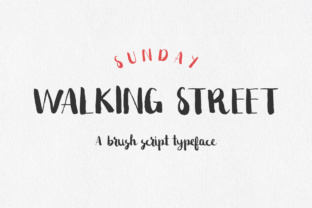
Sunday Walking Street: A Hand-Painted Brush Font for Authentic Design
When you browse font libraries, you encounter countless script and brush typefaces. Many promise a handcrafted feel, but few deliver the genuine texture and rhythm of paint on paper. Sunday Walking Street sets itself apart by tracing back to a physical brush moving across real paper. This typeface was not born in a drawing tablet or a vector editor. It was painted by hand, then carefully digitized to preserve warmth, unevenness, and personality. The result is a relaxed, hand-painted brush font that feels like it belongs on a storefront sign, a creative menu, or a personal invitation.
For designers, small business owners, and content creators, choosing a typeface often involves balancing aesthetic appeal with practical function. Sunday Walking Street occupies a specific niche: it offers character and authenticity without sacrificing readability. This article explores what makes this font distinct, how it compares to other options, when it works best, and where you might want to look elsewhere.
What Makes Sunday Walking Street Distinct?
The defining feature of Sunday Walking Street is its origin. Every letterform was created with a real brush on paper. That means each stroke carries natural variation in pressure, speed, and ink flow. The thickness of lines changes organically. Edges are soft and slightly irregular. The overall impression is relaxed, unhurried, and human—as if someone sat down on a Sunday afternoon and painted letters for the simple joy of it.
This font captures the quiet energy of a leisurely walk through a market street, where signs are hand-painted and nothing looks machine-made. The letterforms have a gentle slant, but they do not feel rigid or formal. The brush texture is present but not overwhelming. It avoids the overly rough or distressed look that can make a font feel artificially aged. Instead, Sunday Walking Street lands in a sweet spot: polished enough for professional use, but raw enough to feel personal.
Another distinctive quality is its character set. The font includes uppercase and lowercase letters, numerals, punctuation, and accented characters. This makes it usable across multiple languages and contexts. The design maintains a consistent hand-painted voice across all glyphs, which is harder to achieve than many realize. When a font is digitized from physical brushwork, the challenge is to preserve the original feel while ensuring each character works well next to its neighbors. Sunday Walking Street manages this balance gracefully.
How Sunday Walking Street Compares with Other Brush and Script Fonts
When evaluating any font, it helps to understand the landscape. Brush fonts generally fall into a few categories: digital brush fonts created entirely in software, handwritten fonts based on pen or marker strokes, and calligraphic scripts that lean into formal lettering traditions. Sunday Walking Street sits between these categories. It has the informality of handwriting but the deliberate structure of a typeface.
Digital brush fonts often look clean and consistent. Every stroke is mathematically smooth, and the spacing is perfectly even. This makes them reliable for large blocks of text or for projects where precision matters. However, they can lack soul. The charm of Sunday Walking Street is the opposite: it embraces imperfection. The organic variation in stroke weight and the subtle irregularities in letter shapes give it a human touch that purely digital fonts rarely replicate.
Compared to handwritten fonts that use pen or marker, Sunday Walking Street offers a different texture. A pen stroke tends to be finer and more uniform. A brush stroke is bolder and more expressive. The paint texture adds depth that a clean marker line cannot match. For projects that need to feel tactile, like product packaging or physical signage, this difference matters.
Calligraphic scripts, on the other hand, are often more formal. They follow strict rules about thick and thin strokes, and they frequently include elaborate flourishes. Sunday Walking Street does not attempt to be calligraphic. Its strokes are straightforward and unpretentious. It is a font for situations where you want warmth and approachability, not formality and grandeur.
Strengths and Best-Fit Use Cases
Sunday Walking Street excels in contexts where authenticity and personality are the goals. Here are some of the strongest use cases:
- Branding for creative businesses: Cafés, bakeries, artisan stores, flower shops, and small boutiques benefit from a font that feels handmade. A logo or a store sign set in Sunday Walking Street communicates care and craftsmanship.
- Invitations and greeting cards: For weddings, parties, or personal notes, the relaxed brush style adds warmth. It looks like someone took the time to paint the words, which is exactly the tone many events want.
- Social media graphics: A quote or announcement in this font stands out because it does not look corporate. It fits well on Instagram, Pinterest, or Facebook, where audiences respond to authentic content.
- Product labels and packaging: Products that emphasize natural ingredients, handmade processes, or local origins can use Sunday Walking Street to reinforce that message. The font becomes part of the product story.
- Editorial headers and pull quotes: In magazines or blogs, a hand-painted header breaks up text and adds visual interest. It signals a shift in tone, inviting the reader to pause.
The font works best at medium to large sizes. Above 24 points, the brush texture and stroke variation become visible and appealing. At very small sizes, some of the subtle details may blur, but the font remains legible down to around 14 points if used sparingly.
Limitations and Tradeoffs to Consider
No font is perfect for every project, and Sunday Walking Street has limitations worth considering. The most important is legibility in extended text. Because the letterforms are based on a single brush stroke, they are not designed for long paragraphs. Reading a novel or a lengthy report in this font would be tiring. The irregular spacing and variable stroke width, while charming, make sustained reading harder than with a simple sans serif or a clean serif.
The font also has a specific personality. It is relaxed and casual. If your project requires a formal, authoritative, or purely professional tone, Sunday Walking Street may feel out of place. Annual reports, legal documents, academic papers, or corporate presentations are better served by more neutral typefaces. The font carries an emotional weight that is perfect for some contexts but distracting in others.
Another practical consideration is character set limitations. While Sunday Walking Street includes accented characters and basic punctuation, it may not support every symbol or diacritic needed for all languages. If your project requires extensive multilingual typesetting, you should check the font's coverage before committing.
Pairing is another factor. Sunday Walking Street is a display font, not a text font. It works best as a headline or accent. You will likely need a complementary font for body text. Serif fonts like Garamond or geometric sans serifs like Futura can pair well, but the combination requires thought. The hand-painted quality of Sunday Walking Street can clash with overly rigid or sterile counterparts.
Decision Factors: Choosing Sunday Walking Street or an Alternative
When deciding whether Sunday Walking Street is right for your project, consider the following questions:
- What tone do I need? If the answer is warm, casual, and personal, this font is a strong candidate. If you need formal, authoritative, or minimal, look elsewhere.
- Where will the text appear? For large headlines, posters, logos, and short phrases, Sunday Walking Street shines. For body text, footnotes, or small labels, a simpler font may serve better.
- How much texture do I want? The brush texture is central to this font's appeal. If you prefer a cleaner look, a digital brush font or a handwritten style with less variation may fit better.
- Am I willing to pair fonts? Sunday Walking Street requires a companion for most projects. If you want a single font that does everything, this is not it.
- Do I need multilingual support? Check the character set carefully. If your project uses languages with special diacritics or symbols, verify coverage before choosing.
If you are torn between Sunday Walking Street and another option, create a side-by-side test. Set the same phrase in both fonts and print it out. Notice how each makes you feel. Pay attention to legibility, personality, and fit with your overall design. Often, the decision becomes clear when you see the fonts in context.
Practical Examples: Where Sunday Walking Street Works Well
Imagine a small coffee shop redesigning its menu. The owner wants the menu to feel cozy, artisanal, and welcoming. The headings for "Coffee," "Tea," and "Pastries" are set in Sunday Walking Street. The brush strokes echo the chalkboard signs and wooden tables. Customers immediately sense the shop's character. The body text explaining each drink is set in a clean sans serif, so it is easy to read. The combination works because each font respects its role.
Another example is a wedding invitation. The couple wants a personal, intimate feel. The invitation uses Sunday Walking Street for the names and the main phrase, "Join us in celebrating." The rest of the details are in a refined serif. The hand-painted quality makes the invitation feel like something the couple created themselves, even though it was professionally designed.
On social media, a wellness blogger uses Sunday Walking Street for weekly quote graphics. The font's relaxed energy matches the theme of slowing down and being present. Followers respond positively because the graphics feel genuine. The font becomes part of the brand identity.
In each case, Sunday Walking Street is not the whole design. It is the accent that carries emotional weight. That is its strength.
Final Considerations for Your Font Selection
Choosing a typeface is a design decision that affects how audiences perceive your work. Sunday Walking Street offers a genuine hand-painted quality that is difficult to find in purely digital fonts. It brings warmth, personality, and a sense of human care to any project that values those qualities.
That said, it is not a universal solution. Its strength is also its limitation: the font has a distinct voice that cannot be bent to every purpose. The key is to recognize when that voice aligns with your goals and when a more neutral or formal font would serve better.
Test Sunday Walking Street in your actual project. Use it for a headline. Pair it with a simple body font. See how it feels. If it makes your design feel more authentic and approachable, it is likely the right choice. If it feels forced or out of place, trust that instinct and explore other options.
At its core, Sunday Walking Street reminds us that fonts are not just tools for reading. They are tools for feeling. The right font can turn a message into an experience. For projects that need a relaxed, human touch, this hand-painted brush font is a choice worth considering.