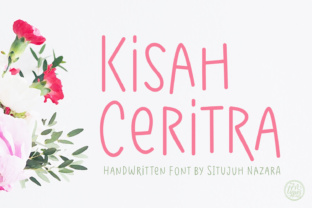
Kisah Ceritra: Evaluating a Playful Handwritten Font with Fluid Legibility
When selecting a typeface for a project, the balance between personality and readability often becomes a central point of evaluation. Kisah Ceritra, a handwritten font created by designer Situjuh Nazara, enters that conversation with an explicit promise: it aims to be playful without sacrificing clarity. For designers, marketers, and content creators weighing their type options, understanding where this font performs well and where it may fall short is essential to making an informed choice. This article provides a balanced look at Kisah Ceritra, examining its characteristics, ideal use cases, tradeoffs, and situations where alternatives might better serve your goals.
What Defines Kisah Ceritra
Kisah Ceritra is a handwritten typeface that draws attention for its fluid letterforms. Unlike many display fonts that prioritize visual impact over readability, Situjuh Nazara designed this font with a clear emphasis on legibility. The strokes are smooth and connected in a way that mimics natural handwriting, yet each character retains enough distinct shape to be recognized quickly. This combination positions Kisah Ceritra in a middle ground: it carries the warmth and informality of hand-drawn lettering but does not push abstraction so far that readers must pause to decode the text.
The playfulness of Kisah Ceritra emerges through subtle irregularities in stroke weight and letter spacing. These features give the font a human, unpolished feel that contrasts with the uniformity of many script fonts. However, the designer avoided extremes. The letters remain proportional and upright enough to support extended reading in short to medium-length passages. This makes Kisah Ceritra different from highly stylized handwritten fonts that prioritize artistic expression over functional use.
For someone evaluating this font, the core question is whether that specific blend of playfulness and legibility aligns with the tone and practical demands of their project. The answer depends heavily on context, audience, and medium.
When Kisah Ceritra Is a Strong Fit
Certain projects benefit directly from the characteristics of Kisah Ceritra. Understanding these scenarios helps readers determine whether this font supports their communication goals.
Branding That Needs Warmth Without Chaos
Professional branding often walks a fine line between approachability and authority. Kisah Ceritra suits brands that want to appear friendly, creative, or handmade without becoming difficult to read. Small businesses, freelance professionals, artisans, and lifestyle brands frequently need a typeface that feels personal but still communicates reliability. Kisah Ceritra can serve as a primary logo font or a supporting accent in branding systems where the tone calls for a human touch. Its fluid strokes suggest motion and spontaneity, which can be valuable for brands in fields like crafts, wellness, children's products, or hospitality.
Projects Where Personality Is the Priority
Less formal work such as invitations, greeting cards, social media graphics, packaging, and personal blogs often demand a typeface that carries emotional weight. Kisah Ceritra’s handwritten quality adds a layer of authenticity that standard sans-serif or serif fonts cannot replicate. In these contexts, the font’s playfulness becomes an asset rather than a distraction. Readers encountering the text in these settings are typically primed for a casual, warm experience, so the informal letterforms reinforce the intended mood.
Short-Form Content Where First Impressions Matter
Headlines, pull quotes, signage, and product labels rely on immediate visual impact. Kisah Ceritra’s legibility at moderate sizes makes it effective for these purposes. The font’s fluid design draws the eye without forcing the reader to work hard to recognize words. For content that needs to be scanned quickly, such as a tagline on a website hero section or a message on a product package, Kisah Ceritra delivers both distinctiveness and speed of comprehension.
Tradeoffs and Considerations
No typeface works universally, and Kisah Ceritra is no exception. Evaluating its limitations honestly helps readers avoid mismatched applications and disappointment.
Legibility at Very Small Sizes
While Kisah Ceritra is legible for a handwritten font, its fluid strokes and variable letter widths can become problematic at extremely small sizes. Body text in print or digital interfaces below 10 or 12 points may cause readers to struggle with character recognition, especially for letters like “a,” “e,” and “o” that rely on open counters. If your project requires extensive body copy at small sizes, a more neutral typeface or a dedicated small-text script would serve better. Kisah Ceritra performs optimally at medium to large sizes where its details remain visible.
Limited Formal Authority
Because of its playful handwritten nature, Kisah Ceritra projects informality. This is a strength in many contexts but a drawback in others. Legal documents, financial reports, corporate communications, academic papers, or any content that demands a serious or authoritative tone will likely feel mismatched with Kisah Ceritra. Readers may perceive the font as unserious or inappropriate for formal contexts. In such situations, a clean serif or sans-serif typeface provides the gravitas that the content requires.
Character Set and Language Support
Before committing to Kisah Ceritra, it is advisable to verify the font’s character coverage. Some handwritten fonts offer limited support for diacritics, special characters, or non-Latin scripts. If your project involves multilingual content, specific punctuation, or custom ligatures, you may find that Kisah Ceritra does not include every glyph you need. Situjuh Nazara designed the font with a focus on core Latin characters, so checking the full character map against your content requirements is a practical step before finalizing your choice.
When Alternatives May Be Worth Considering
A thoughtful evaluation also involves recognizing when another typeface might serve your goals better than Kisah Ceritra. Here are several scenarios where exploring alternatives makes sense.
High-Volume Body Text Across Long Documents
For eBooks, reports, articles, or any project where readers must process large amounts of text over extended periods, Kisah Ceritra is not the ideal choice. Even at larger sizes, the handwritten style introduces visual fatigue more quickly than a conventional book face. A serif typeface designed for extended reading, such as a Garamond, Baskerville, or a humanist sans-serif like Frutiger, would offer greater reading comfort over many pages. Kisah Ceritra works best in doses rather than as the sole typeface for a lengthy document.
Highly Consistent Corporate or Editorial Branding
Brands that require absolute uniformity across all communications, especially in large organizations with multiple contributors, may find Kisah Ceritra’s fluid irregularities difficult to manage. The font’s natural variation, while charming, can lead to inconsistencies in layout rhythm, line breaks, and overall visual alignment. A more structured script or a neutral typeface with a dedicated italic style might provide the desired personality without the unpredictability that comes with true handwritten forms.
Digital Interfaces with Complex Hierarchy
In user interfaces where information hierarchy depends on clear distinctions between headings, subheadings, body text, and labels, Kisah Ceritra’s singular voice can flatten the visual structure. If you need multiple levels of emphasis and contrast, pairing Kisah Ceritra with a clean sans-serif for UI elements may work, but relying on it alone for all text levels often results in a cluttered or monotonous interface. For digital products where clarity and scanability are paramount, a type system with distinct weights and styles offers more control.
Practical Decision-Making Insights
Evaluating whether Kisah Ceritra aligns with your needs involves asking a few targeted questions before you commit.
- What is the primary medium? If your project is print or digital at moderate to large sizes, Kisah Ceritra is likely a strong contender. For small-screen mobile interfaces or fine print, test the font at the actual dimensions it will be used before deciding.
- Who is the audience? Consider whether your readers expect warmth and personality or authority and formality. Kisah Ceritra works well for audiences receptive to a friendly, handmade aesthetic. It may undermine credibility with audiences accustomed to conventional corporate design.
- How much text will the font carry? For short bursts of text, headlines, or accent elements, Kisah Ceritra shines. For paragraphs, long captions, or technical content, consider using it sparingly or pairing it with a more neutral body typeface.
- Does the font support your full content set? Verify character coverage early. If your content includes characters not present in Kisah Ceritra, you will need to supplement or choose an alternative.
- Does the font’s tone match your brand personality? A sincere match between typeface and brand voice creates coherence. If your brand values include playfulness, approachability, or craftsmanship, Kisah Ceritra reinforces those attributes. If your brand leans toward precision, luxury, or authority, another typeface may serve you better.
Summary of Fit Scenarios
For clarity, Kisah Ceritra performs best in projects that prioritize personality, warmth, and visual interest over rigid formality or extended reading comfort. It is a practical choice for logos, packaging, social media graphics, invitations, and short promotional content. It is less suited to lengthy articles, formal documents, small-print applications, and interfaces that require strict visual hierarchy.
The font’s creator, Situjuh Nazara, deliberately balanced playfulness with legibility, and that balance is Kisah Ceritra’s defining strength. It offers a middle path between expressive handwriting and readable type, making it a useful tool for designers who need both character and clarity. By evaluating your project’s specific conditions against the font’s natural strengths and limitations, you can decide whether Kisah Ceritra is the right fit or whether another typeface would better serve your goals.
Ultimately, the most effective typeface is the one that supports your content without drawing unnecessary attention to itself. Kisah Ceritra achieves that in contexts where a personal, fluid voice is appropriate. For everything else, the wise approach is to recognize where its playful nature becomes a liability and to explore alternatives that align more closely with the demands of the task at hand.