Chesan: A Playful Handwritten Font with Bold Legibility
If you have ever scrolled through font libraries hoping to find a typeface that feels both energetic and readable, you have likely encountered the dilemma of choosing between personality and practicality. Many handwritten fonts lean heavily into whimsy, sacrificing clarity at small sizes or in long text blocks. Others play it so safe that they lose any sense of character. Chesan enters this space as a refreshing middle ground—a playful handwritten font that wraps a cartoonesque soul inside surprisingly bold, legible letterforms. After working with it across several projects, I have found that it manages to be fun without becoming frivolous, and bold without becoming hard to read.
What Makes Chesan Stand Out
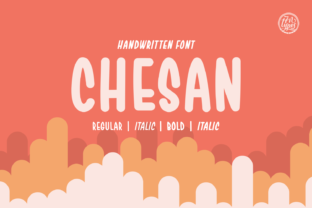
At first glance, Chesan greets you with curves and strokes that feel drawn by hand rather than generated by algorithm. There is an organic bounce to the baseline, a slight irregularity in the swashes, and a warmth that instantly signals approachability. But what separates Chesan from the crowded field of handwritten typefaces is its structure. The letterforms are built with thick, confident strokes that hold up well even when scaled down or placed against busy backgrounds.
Legibility in a handwritten font often comes down to how clearly each character distinguishes itself from similar ones. Chesan handles this well—lowercase a and o stay distinct, ascenders and descenders are generous without being exaggerated, and the spacing between letters feels open enough to avoid crowding. For a font that deliberately flirts with a cartoonesque style, this level of readability is not automatic; it requires careful design discipline behind the playful exterior.
Another characteristic that deserves attention is the weight distribution. The bold lines in Chesan are not uniformly heavy—they vary in thickness just enough to mimic natural hand pressure, giving the text a dynamic rhythm. This makes longer passages feel less monotonous and draws the reader's eye along the line naturally.
The Four Variations: Regular, Italic, Bold, and Bold Italic
Chesan comes packaged with four core variations, and understanding what each brings can help you deploy them effectively.
- Regular – The default weight captures the essence of Chesan: playful, slightly bouncy, and highly readable. It works well for short paragraphs, headlines, and callout text where you want personality without shouting.
- Italic – The italic slant adds a layer of motion and informality. It is not a simple skew of the regular glyphs; the letterforms have been redrawn to lean naturally while preserving legibility. Use it for emphasis, subheadings, or quotes where you want a conversational tone.
- Bold – This variation thickens the strokes noticeably, making the font punchier and more commanding. It retains the handwritten character but gains presence. Bold Chesan is excellent for primary headlines, posters, and hero text where you need impact.
- Bold Italic – Combining the weight of the bold with the slant of the italic, this variation is the most expressive of the set. It works best sparingly—perhaps for a single powerful word or a short phrase that needs to stand out dramatically.
Having all four variations available within the same family makes Chesan more versatile than a single-weight handwritten font. You can build a visual hierarchy across headings, subheadings, and body text using just this one family, which keeps your design cohesive.
Where Chesan Shines: Real-World Applications
Through experimenting with Chesan in different contexts, I have identified several scenarios where it performs particularly well.
Branding and Logo Design
Small businesses, creative studios, and personal brands often seek a typeface that communicates warmth and approachability. Chesan's handwritten feel pairs naturally with logos for cafes, children's products, handmade goods, and lifestyle services. The bold weight anchors a mark, while the regular weight can support taglines or secondary text. Because the font retains legibility at smaller sizes, it also works on social media profile images, favicons, and app icons.
Packaging and Product Labels
Products that want to convey artisanal quality or homemade charm benefit from Chesan's tactile appearance. Think craft beer labels, organic food packaging, skincare products, or stationery sets. The bold lines ensure that product names remain readable on crowded shelves, while the playful curves communicate a human touch that rigid sans-serif fonts cannot replicate.
Children's Books and Educational Materials
Young readers respond well to type that feels friendly and unhurried. Chesan's cartoonesque quality makes it a natural fit for children's book titles, activity sheets, classroom posters, and early learning apps. The high legibility means that even emerging readers can distinguish letters easily, which reduces frustration during early literacy practice.
Social Media and Digital Content
Instagram stories, YouTube thumbnails, blog headers, and promotional graphics all compete for attention in crowded feeds. Chesan's bold strokes stand out on mobile screens, and its handwritten style adds personality that can differentiate your content from polished-but-impersonal templates. The italic variation works well for captions or pull quotes, while the bold weight anchors the main message.
Event Posters and Flyers
Concerts, festivals, markets, and community events often rely on visual flair to grab attention. Chesan can headline a poster with energy, and its variations let you layer information without switching to a second font family. The playful tone suits casual and creative events; for formal occasions, you may want to pair it with a more restrained complementary font.
Who Benefits Most from Chesan
While Chesan is broadly useful, certain users will find it especially valuable.
- Small business owners who manage their own branding and social media can adopt Chesan as a consistent voice across platforms without needing a large font library.
- Graphic designers working on projects that require a handwritten aesthetic but cannot afford to sacrifice legibility will appreciate the balance Chesan strikes.
- Content creators and influencers who want their thumbnails, channel art, and merch to feel personal and approachable can use Chesan to reinforce their brand identity.
- Educators and parents creating printable materials for children will find Chesan's clarity helpful for early readers.
- Event organizers designing promotional materials on a tight timeline can rely on Chesan's versatility to produce cohesive visuals quickly.
Strengths and Considerations
No typeface is perfect for every situation, and understanding Chesan's limitations helps you use it wisely.
Strengths
- Legibility at small sizes – Handwritten fonts often blur or become ambiguous when scaled down. Chesan's bold strokes and open spacing keep it readable even at 12pt or 14pt.
- Built-in hierarchy – With four variations, you can create visual contrast within a single font family, reducing the need to pair multiple typefaces.
- Emotional warmth – The handwritten, cartoonesque style immediately communicates approachability, creativity, and human touch.
- Versatility across media – Chesan works in print, digital, and physical formats without losing its character.
Considerations and Limitations
- Not suited for extended body text – Like most handwritten fonts, Chesan is best reserved for short to medium-length passages. Reading long paragraphs in a handwritten style can fatigue the eye.
- Limited formality – The playful nature of Chesan makes it inappropriate for legal documents, academic papers, corporate reports, or other formal contexts.
- Pairing requirements – For projects that need both display text and long body text, you will likely need to pair Chesan with a neutral sans-serif or serif font for the main content.
- Licensing considerations – As with any commercial font, check the license terms for your specific use case, especially for branding, merchandise, or app embedding.
Evaluating Chesan for Your Project
Before committing to Chesan, ask yourself a few questions to determine whether it fits your needs.
- What tone am I aiming for? If your project calls for warmth, playfulness, or creativity, Chesan is a strong candidate. If you need formality, authority, or minimalism, look elsewhere.
- How much text will appear in Chesan? For headlines, short paragraphs, and callouts, it excels. For pages of body copy, consider a more neutral companion font.
- What output format matters most? Chesan performs well in print and on screens, but test it at the actual size and resolution you will use—especially for small digital text.
- Do I need multiple weights? Having Regular, Italic, Bold, and Bold Italic gives you flexibility. If your project relies heavily on hierarchy within the same font, Chesan covers that need.
- Does the brand personality align? Chesan works beautifully for brands that want to feel friendly, handmade, or creative. If your brand voice is serious or corporate, the mismatch will be noticeable.
A practical way to test Chesan is to build a simple mockup with your actual content—a headline, a subheading, a short paragraph, and a call-to-action. See how the four variations interact, and try scaling the text up and down to find the sweet spot where legibility and personality balance best.
Final Thoughts on Chesan
Chesan occupies a useful niche in the typography landscape. It does not pretend to be a workhorse font for thousands of words of body text, nor does it sacrifice readability for the sake of style. Instead, it offers a playful handwritten voice that remains clear and confident across a range of applications. Small business owners, designers, content creators, and educators all have something to gain from adding it to their toolkit.
The next time you reach for a handwritten font for a project, consider what you really need: personality without confusion, warmth without sloppiness, and versatility without complexity. Chesan delivers on each of those fronts—and that is a combination worth bookmarking.