Smudge Font: A Gritty Display Typeface for Designers Who Want Imperfection
Most typefaces are engineered for clarity. Their edges are sharp, curves are mathematically smooth, and every letter sits in perfect alignment. Smudge takes the opposite approach. Inspired by ink traps, over-inked printing, and the wear that comes from repeated use, this display font leans into messiness. It looks like a letterpress plate that has seen too many runs, or a rubber stamp pressed with too much enthusiasm. For designers working on projects that need an analog, hand-crafted feel, Smudge offers something that clean digital fonts cannot replicate.
What Makes Smudge Distinct?
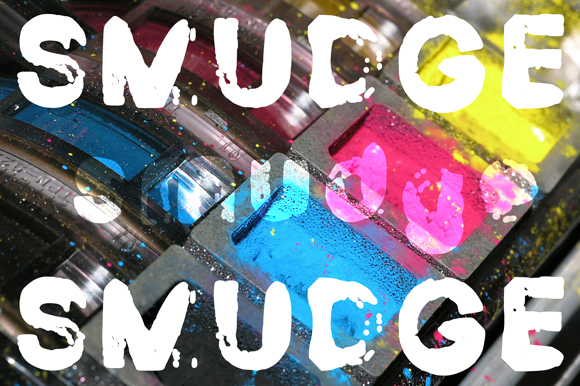
Smudge is not a scrubbed, vector-perfect typeface. Its characters carry irregular strokes, spots of simulated ink bleed, and intentional gaps where pressure might have lifted. Some letters appear partially filled, others have edges that taper off as if ink soaked into coarse paper. This unpredictability is deliberate. Unlike a distressed font that applies a uniform grunge texture over clean letters, Smudge integrates the dirt into the letterforms themselves. Each glyph feels like a physical object that has been handled, not a digital filter applied afterward.
The font works best at display sizes—typically 36 points and above. At smaller sizes, the smudges and breaks can make characters hard to distinguish. That tradeoff is central to its design philosophy. Smudge prioritizes personality over legibility. It is meant to be felt as much as read. This makes it a poor choice for body text but a strong one for headlines, logos, posters, and any setting where you want the typeface to carry emotion.
Where Smudge Excels vs. Cleaner Alternatives
Compare Smudge to a clean rounded sans-serif or a crisp slab serif. The clean option is professional, reliable, and predictable. It fits corporate reports, app interfaces, and news articles. Smudge fits the opposite end of the spectrum. It belongs on gig posters for experimental music, packaging for small-batch coffee roasters, or the cover of a zine about urban decay. In these contexts, a polished font can feel out of touch. Smudge signals that the maker chose not to polish, that the work is closer to the raw material.
Another comparison is with hand-drawn or script fonts that emulate calligraphy. Those fonts often try to look elegant or personal. Smudge does not aim for elegance. It aims for authenticity of a different kind—the authenticity of a workshop, a basement print studio, or a sign that has weathered city streets. While a brush script might convey warmth, Smudge conveys grit. The choice between them depends on the mood you need. For an organic, honest feel, Smudge often wins. For a refined handcrafted look, a brush script may be better.
There are also fonts that mimic typewriter imperfections—uneven ink, slight misalignments. Smudge goes further by introducing areas of heavy pooling and even missing sections of lines. It is not subtle. That boldness is its main strength. In a design that needs to stand out on a crowded shelf or a cluttered feed, Smudge commands attention because it looks unlike the surrounding noise.
When Smudge Isn’t the Right Fit
Smudge’s limitations are real. Readability drops quickly below 24 points, especially on screens. If your audience includes older readers or people with visual impairments, Smudge can create barriers. For long headlines intended to be read at a glance—like a website hero banner—the messy ink may slow down comprehension. In contexts where trust is important, such as legal notices, medical information, or financial documents, Smudge undermines the required authority.
Another limitation is format responsiveness. On some digital screens, particularly those with lower resolution or smaller pixel densities, the fine ink details can blur into noise. What looks tactile on a large poster at 300 DPI may appear muddy on a mobile phone. Designers should always test Smudge at the actual output size and medium before committing. For print projects, the font behaves more predictably, but even there, you need to consider paper stock. Heavy textured paper enhances the dirty effect; glossy stock can make the smudges look artificial.
The style also carries strong cultural associations. If your target audience expects clean, modern, minimalist design—as in tech products, premium services, or academic publications—Smudge may signal carelessness rather than intention. It is crucial to match the font’s personality with the brand’s voice. Using Smudge for a high-end legal firm would likely backfire, while a record label focused on lo-fi aesthetics would find it perfectly aligned.
Deciding Between Smudge and Other Display Fonts
When evaluating Smudge against other messy or distressed display fonts, consider three factors: the source of the mess, the level of control, and the intended impression. Some distressed fonts apply a uniform overlay of scratches or grain. Smudge does not just distress; it alters the shape of each letter unevenly. That means you have less control over legibility but gain a more organic texture. If you need a font that is dirty but still highly readable, a distressed sans-serif might serve better. If you want the font to feel like an artifact pulled from a dirty print shop, Smudge is the stronger choice.
Another decision factor is how the font behaves in a variable weight family. Smudge is typically available in only one or two weights—often regular and bold—because the messy design does not scale gracefully across many variations. If your project demands a full family with light, semibold, and extended versions, look elsewhere. Smudge is best used as a single hero typeface that carries the visual weight.
For designs that pair Smudge with a secondary font, choose a clean, no-nonsense body face. A neutral sans-serif like a robust workhorse complements the font without competing. The contrast between polished and rough can reinforce the intended aesthetic. Avoid pairing Smudge with another busy display font; the result will be chaotic and hard to parse.
Practical Examples: Smudge in Action
Imagine a flyer for a punk band playing a basement show. The headline uses Smudge in all caps, sized at 72 points. The letters are uneven, some appear to have ink splatters near the edges, and the spacing is loose enough that the dirtiness stays readable. Below, set the date and venue in a clean sans-serif. The contrast works. The audience immediately reads the energy of the event without needing to decode a complicated layout.
Another scenario: a limited-run art book about analog photography. The cover uses Smudge for the title, printed on uncoated stock. The ink effect mirrors the photographs inside—grainy, imperfect, real. A digital-friendly font would not carry the same tactile promise. For this project, Smudge is not just a typeface; it is a design element that reinforces the content.
On the other hand, consider a food brand that wants to appear rustic and handmade. Smudge could work for the logo, but only if the product itself has a rough edge, like a micro-roastery or a craft brewery. A smooth prepackaged food product might come across as trying too hard. The authenticity of Smudge depends on the context matching the visual style.
Strengths and Limitations at a Glance
- Strength: High personality and recall. People remember seeing Smudge because it does not look like most digital text.
- Strength: Excellent for print on textured or uncoated paper where ink bleed can look natural.
- Strength: Strong for niche markets that value raw, unpolished aesthetics—punk, indie, craft, experimental.
- Limitation: Poor legibility at small sizes, especially on screens.
- Limitation: Limited weight options; not suitable for complex typographic systems.
- Limitation: Risk of looking gimmicky if used in a context that demands sophistication or clarity.
Making an Informed Choice
Before you download or purchase Smudge, ask yourself a few questions. Does the project need to feel physical and tactile? Will the audience appreciate imperfection, or will they interpret it as sloppiness? Can you control the output medium enough to preserve the font’s details? If you answered yes to all three, Smudge is worth testing. If the answer is no to any of them, you may need a different tool.
Testing is critical. Generate a sample of your headline phrase in Smudge at the intended size and medium. Show it to people who match your target audience and ask what they see. If they read the words easily and describe the font as “rough” or “used,” you are on track. If they struggle to read the text or call it “messy” in a negative sense, reconsider. The line between intentional dirt and unintended clutter is thin, and Smudge sits right on that edge.
For designers who already work with distressed styles, Smudge is a valuable addition to the toolbox. It fills a gap between fully clean and uniformly grunge fonts. It can add depth to a poster, personality to a brand, and a sense of history to a digital file. But it is not a universal solution. Like any specialty tool, its effectiveness depends on knowing when to pull it out and when to leave it in the drawer.
The best approach is to treat Smudge as a deliberate choice, not a default. Pair it with clean elements. Reserve it for hero moments. Let the imperfections work for the message, not against it. When used with intention, Smudge can transform a design from something that is expected into something that feels discovered.