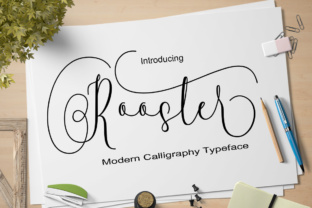
Rooster Script: A Delicate Calligraphy Font with Character
Every now and then a typeface comes along that feels less like a tool and more like a signature. Rooster Script is one of those. It’s a calligraphy font built from thin, hand-drawn glyphs—each letter carrying the slight unevenness and personality that only real strokes can deliver. With over 570 unique glyphs and 384 alternate characters, this is not a quick, cookie-cutter script. It’s a considered design asset for anyone who wants their words to feel personal without sacrificing polish.
When you first look at Rooster Script, the most obvious quality is its lightness. These letters don’t shout. They trace across the page with a kind of restrained elegance—slender, airy, and deliberate. The strokes are fine but not fragile. There’s a consistent rhythm to the letterforms, but enough variation to keep things from feeling mechanical. In a world of bold brush scripts and heavy signatures, Rooster Script offers a quieter, more refined alternative. It’s a script font that feels more like handwritten correspondence than a loud marketing headline, and that quality makes it surprisingly versatile.
What Makes Rooster Script Stand Out in Modern Typography
Most display fonts lean into drama. They’re built for impact—thick strokes, dramatic swashes, exaggerated proportions. Rooster Script takes a different path. Its thin, drawn quality gives it an intimate, almost editorial feel. This is a typeface that works best when you want proximity with your audience, not distance. It reads like a note left on a desk, not a billboard on a highway.
The 384 alternate characters are not an afterthought. They actively shape how the font behaves in different settings. Need a more understated lowercase for body text in a brand guideline? Done. Want a flourished capital for a wedding invitation header? Also ready. These alternates allow you to dial the personality up or down without switching fonts. That kind of flexibility is rare in a script typeface, and it’s what pushes Rooster Script from a novelty into a genuine design asset for branding and packaging work.
From a technical standpoint, the sheer number of glyphs—over 570—means you’re getting multilingual support and a range of punctuation, ligatures, and contextual alternates that most handwritten fonts simply skip. If you’ve ever tried to typeset a script font in a real project only to find missing characters or broken kerning, you’ll appreciate the completeness here. Rooster Script behaves like a professional tool, not a decorative afterthought.
Where Rooster Script Shines Across Creative and Commercial Projects
The real test for any font is not how it looks in a specimen sheet but how it performs in actual use. Rooster Script has a clear sweet spot: any project where you want to communicate warmth, attentiveness, and a handcrafted sensibility. That makes it a natural fit for a range of contexts.
In brand identity, especially for small businesses, boutiques, and lifestyle brands, this font brings a human touch without looking amateurish. Think of a skincare line, a coffee roaster, a stationery shop—any brand that wants to feel approachable but still intentional. The thin strokes read as delicate and curated, which works particularly well when paired with a clean sans serif font on packaging or a serif font in editorial materials. That contrast—delicate script next to something sturdy and geometric—creates a visual hierarchy that feels modern and grounded.
In logo design, Rooster Script can serve as the primary wordmark for names with a softer identity. It’s especially effective for personal brands, artist signatures, and product lines where the founder’s name is the brand. The alternates let you customize the lockup so it feels bespoke, which is a huge advantage when you’re trying to avoid a generic logo.
For editorial design and web design, think pull quotes, headings, and accent text. Rooster Script isn’t designed for long body copy—that would be a mistake with any display font—but it excels in small doses where you need to break up a dense layout with something lyrical. On a website, it works beautifully for hero section headlines or decorative drop caps that add a hand-drawn element to an otherwise clean grid.
Social media graphics are another natural home. The font’s slender lines render well on screens, especially at sizes where thicker scripts tend to clutter. When you pair Rooster Script with muted backgrounds and natural textures—think linen, paper, or soft gradients—you get a cohesive, lifestyle-oriented visual that performs well on Instagram, Pinterest, and branded content.
How Rooster Script Influences Readability, Hierarchy, and Brand Perception
One of the most underappreciated qualities of a good display font is how it affects the experience of reading, not just the look of a page. Rooster Script, with its measured letter spacing and consistent slant, guides the eye without forcing it. There’s a natural flow to the connections between characters, which makes even longer words feel approachable. That’s a direct result of thoughtful glyph design—each alternate is built with a sense of how it sits next to its neighbors.
In terms of visual hierarchy, Rooster Script functions best as the top of the pyramid. Use it for primary headlines, product names, or signature elements. Let your supporting sans serif font or serif font handle the details. This separation gives the script room to breathe and keeps your layout from feeling chaotic. A common mistake with ornate fonts is using them everywhere. The better approach is to reserve Rooster Script for the moments that need emotional weight—the brand name, the tagline, the call to action—and let simpler typefaces do the heavy lifting.
From a brand perception standpoint, using Rooster Script signals attention to detail. It says you cared enough to choose something with nuance, not just the default system font. For publishers and content creators, that translates to a more polished, professional impression. For entrepreneurs and small business owners, it can mean the difference between looking like a hobby and looking like a legitimate operation. The font’s delicate nature communicates quality and thoughtfulness—two qualities that are hard to fake with typography alone.
Consistency also improves when you have a font like this in your toolkit. Because Rooster Script includes so many alternates, you can maintain a handcrafted look across multiple pieces of collateral without repeating the exact same letterforms every time. That variety keeps the brand identity feeling alive without ever needing to switch to a different typeface.
Practical Guidance for Choosing and Using Rooster Script in Your Projects
Before you commit to any premium font, it’s worth asking a few practical questions. Start with project fit. Is the brand or project asking for warmth, elegance, or a handcrafted feel? If yes, Rooster Script deserves strong consideration. If the brand relies on industrial or hyper-modern aesthetics, a more geometric sans serif font or a sturdy serif font will probably serve better. Know the context before you fall in love with the letterforms.
Next, test font pairings. Rooster Script pairs naturally with neutral sans serif fonts like clean grotesques or humanist styles. It also works nicely with thin serif fonts for editorial projects. Avoid pairing it with another script or handwritten font—you’ll lose contrast, and the hierarchy will flatten. Stick with one expressive element per layout, and let everything else recede.
Review the included styles and alternates carefully. With 384 alternates, you have options. But options only help if you know what they do. Spend time understanding the stylistic sets—some alternates are swash capitals, others are simplified forms for smaller sizes. Use the simplified alternates for web or small print, and save the flourished versions for large headlines or logo work where you want the detail to be visible.
Readability considerations matter too. At very small sizes—below 18 points in print or 24px on screen—Rooster Script’s thin strokes can become difficult to read. This is a display font, not a body text font. Use it where it can be seen clearly, and don’t be afraid to increase tracking slightly if the letters feel too tight. A little breathing room often improves legibility in script fonts more than any other adjustment.
Finally, check the commercial licensing. If you’re a designer or small business owner using Rooster Script in client work, logos, packaging, or digital products, make sure you have the right license for your use case. Many premium fonts require extended licenses for branding applications or merchandise. That’s standard practice, and it protects both you and the type designer. A quick read of the license terms saves headaches later.
For publishers and marketers, Rooster Script can also serve as a consistent visual anchor across campaigns. Once you settle on a primary application—say, a signature style for pull quotes in a magazine or a recurring accent in email headers—stick with it. Consistency in typography builds brand recognition faster than almost any other design element. That’s true whether you’re running a small Etsy shop or managing a multi-channel content strategy.
Rooster Script is one of those creative fonts that rewards patience. It’s not a one-size-fits-all solution, but in the right hands and the right project, it brings a level of refinement that elevates everything around it. Whether you’re building a brand identity, designing packaging, crafting social media graphics, or working on editorial design, this typeface offers the kind of character that audiences notice—even if they can’t quite name why. And that’s exactly what a thoughtful design asset should do.