Salwa: A Modern Calligraphy Font for Authentic Branding
If you have been searching for a typeface that brings warmth without sacrificing professionalism, Salwa deserves a close look. Created by RT Creative 86, this modern calligraphy font strikes a balance between expressive hand-lettering and polished readability. It is not one of those script fonts that looks beautiful in a specimen but falls apart in real-world use. Salwa was designed with intention, and that shows the moment you start placing it into mockups, social templates, or packaging drafts.
Calligraphy fonts often get pigeonholed as wedding-only or too ornate for serious brand work. Salwa challenges that assumption. It carries enough structure to feel intentional in a logo, yet it retains the organic flow that makes handwritten typography feel human and approachable. For designers, marketers, and small business owners who want to communicate personality without shouting, Salwa is a strong contender.
What Makes Salwa Stand Out Visually
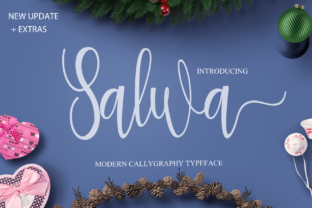
Salwa belongs to the script font category, but it leans more toward contemporary calligraphy than traditional formal script. The letterforms are fluid without being overly swirly. There is a natural rhythm to the strokes—some letters connect, others break away just enough to create breathing room. This makes it highly legible at display sizes while still feeling handcrafted.
The font carries a moderate contrast between thick and thin strokes. Not so dramatic that it feels like a copperplate revival, but enough to give each character dimension. The x-height is generous, which helps with readability when you scale it down for subheadings or shorter body text blocks. Salwa also includes alternate glyphs and stylistic sets, allowing you to customize the flow of words in a logo or headline. This is a practical feature, not just a decorative extra. When you have two repeating letters in a word, having alternate forms prevents awkward visual repetition.
Personality-wise, Salwa feels friendly, confident, and modern. It is not trying to imitate vintage calligraphy or mimic a specific historical style. It feels like something a contemporary lettering artist would create with a pointed pen today. That makes it versatile enough for brands that want to look current but not trendy in a disposable way.
Where Salwa Works Best Across Projects
Because Salwa is a display font at its core, it shines in applications where you need typography to carry emotion and presence. Here are some of the most effective use cases I have seen in real client work and personal projects.
Logo Design and Brand Identity
Salwa works exceptionally well as a standalone wordmark for lifestyle brands, beauty and wellness businesses, boutique cafes, creative agencies, and personal brands. The organic flow of the letters gives logos a bespoke feel without requiring custom hand-lettering for every application. Pair it with a clean sans serif font for taglines or secondary text, and you have a complete identity system that feels intentional. For example, a skincare brand could use Salwa for the brand name and a neutral sans serif like Montserrat or Inter for product descriptors.
Editorial and Packaging Design
In editorial design, Salwa works beautifully for pull quotes, section openers, and cover headlines where you want a human touch. On packaging, it brings warmth to product names, ingredient highlights, and brand storytelling copy. I have seen it used on candle labels, coffee bag tags, and natural skincare boxes. The key is to let Salwa take the lead and keep supporting typography simple. Overloading a package with multiple script fonts is a common mistake. Salwa can handle the personality on its own.
Social Media Graphics and Web Design
For social media graphics, Salwa adds a handcrafted feel to quotes, announcements, and promotional posts. It pairs well with minimal layouts and plenty of whitespace. In web design, Salwa is best reserved for hero headlines, navigation accents, or call-to-action buttons where you want to draw the eye. Because it is a script font, it is not ideal for long paragraphs on screen. But for short, impactful text, it performs well across browsers when loaded as a web font.
Personal and Craft Projects
Hobbyists and crafters will find Salwa useful for greeting cards, wedding invitations, journal covers, and DIY branding for small Etsy shops. The font includes enough characters and ligatures to create polished, professional-looking results without needing advanced design skills.
How Salwa Influences Readability and Visual Hierarchy
One of the biggest challenges with handwritten font choices is maintaining readability while preserving personality. Salwa handles this well because of its consistent stroke contrast and open counters. Letters like a, e, and o remain clearly distinguishable, which is not always the case in more exaggerated script fonts.
In a layout, Salwa naturally becomes the focal point. Its organic shapes contrast with geometric serif font or sans serif font pairings, creating clear visual hierarchy. If you place a headline in Salwa above body text set in a neutral serif, the reader's eye goes directly to the headline first. This is useful for landing pages, print ads, and editorial spreads where you want to guide attention without relying solely on size or color.
From a brand perception standpoint, Salwa communicates approachability and craftsmanship. Brands that use it tend to feel more personal and less corporate. That can be a strategic advantage for small businesses, consultants, and creative professionals who want to build trust through authenticity. Consistency matters too. Using Salwa across your website headers, social templates, and printed materials creates a cohesive visual voice. Over time, that repetition builds brand recognition—people start associating the font's personality with your business.
Practical Guidance for Choosing and Using Salwa
Before committing to Salwa for a project, there are a few practical considerations worth working through. These are the same questions I walk through with clients when selecting a premium font for their identity.
Evaluate Project Fit
Ask yourself whether the project needs a human, warm, or expressive tone. If the answer is yes, Salwa is worth testing. If the project requires strict neutrality or ultra-minimalist aesthetics, a cleaner sans serif or modern serif might serve better. Salwa works best when personality is part of the brief, not an afterthought.
Test Font Pairings Early
Salwa pairs well with a range of creative font styles, but not all pairings are equal. A neutral sans serif like Lato, Open Sans, or Poppins keeps the focus on Salwa without competing. For a more editorial feel, try pairing it with a refined serif like Playfair Display or Lora. Avoid pairing Salwa with another script or handwritten font—that creates visual noise and weakens hierarchy. Test your pairings in context: mock up a logo with a tagline, a social post with a headline and body text, and a product label. See how the combination holds up across formats.
Review Available Styles and Licensing
Salwa is a commercial font, which means you need a proper license for business use. Check whether the license covers web embedding, app integration, and print runs for products you intend to sell. RT Creative 86 typically offers standard and extended licensing options. If you are a designer purchasing for client work, confirm that the license allows for transfer or multi-user access if needed. This is one area where skipping the fine print can cause problems later, especially if a client wants to use the font across multiple platforms or sell products with the typeface on packaging.
Consider Readability at Different Sizes
Salwa is primarily a display font, so it performs best at 18 points and above. For smaller text, especially on screen, test it in your actual layout. Some script fonts lose legibility quickly at small sizes. I recommend using Salwa for headlines, logos, short phrases, and accents, and pairing it with a simpler font for body copy. This keeps your design readable while preserving the handcrafted feel.
Final Thoughts on Salwa as a Design Asset
Salwa from RT Creative 86 is a well-crafted addition to any designer's toolkit. It offers the warmth of hand-lettering without the inconsistency that often comes with purely organic scripts. For entrepreneurs building a brand, marketers crafting visual content, or hobbyists working on personal projects, it delivers personality and professionalism in equal measure.
What I appreciate most about Salwa is that it does not try to do everything. It knows it is a display script, and it excels in that role. When you use it thoughtfully—paired with clean typography, given enough space, and applied to projects that benefit from a human touch—it elevates the work. That is the mark of a good typeface in any category. If you are looking for a modern typography option that feels personal without being precious, Salwa is worth adding to your list of go-to design assets.