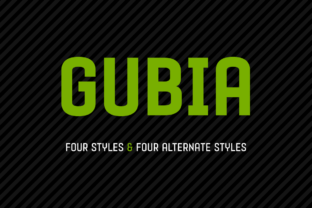
Gubia Family: A Geometric Sans Serif Built for Clarity and Character
There is a quiet challenge that every designer, business owner, and content creator eventually faces: finding a typeface that does not shout for attention but still manages to hold a room. You want something clean enough for a headline, readable enough for a short paragraph, and flexible enough to adapt to different moods. The Gubia Family, designed for Graviton Font Foundry by Pablo Balcells, steps into that space with a geometric sans serif approach that balances precision with personality. It is not trying to reinvent typography—it is trying to make your work look effortlessly polished.
What makes this family worth your time is not just the crisp geometry of its letterforms. It is the quiet thoughtfulness behind the design decisions. Balcells has created a typeface that is slightly condensed, which means it takes up less horizontal space without sacrificing legibility. That alone makes it practical for everything from a bold event poster to a compact product packaging label. But beyond the proportions, there is a deeper layer: the Gubia Family offers both standard and alternate styles, giving you two distinct voices from a single font family. Standard cuts lean classic and dependable; alternates bring a playful, almost unexpected energy. That duality is rare, and it is where the real value lives.
A Typeface Designed for Real Work
When you sit down to choose a font for a project, you are not just picking shapes. You are setting a tone. The Gubia Family understands this because it was built from the ground up for practical use. It comes in 8 styles: 4 weights, each with its own alternate version. That means you get a thin, regular, medium, and bold—plus the corresponding alternates—giving you a full toolkit without overwhelming your font menu. Every style includes small caps, which is a blessing for anyone who has ever had to fake small caps by scaling down full-size capitals. And the glyph coverage extends across multiple languages, so if you work with international clients or multilingual content, you are covered.
Let me give you a concrete example. Imagine you are designing a website for a boutique coffee roaster. The homepage needs a strong headline that feels artisanal but not pretentious. The Gubia Family in its standard bold weight gives you that clean, geometric presence—sharp edges, even strokes, a slight vertical emphasis that draws the eye downward naturally. Then, for the product descriptions, you drop into the regular weight with alternates activated. Suddenly, the text feels a little warmer, a little more human. The alternate characters introduce subtle variations in letterforms—a different 'a', a more open 'g'—that break the monotony without breaking the coherence. That is the kind of flexibility that saves you from needing two separate typefaces for one project.
Where the Gubia Family Excels Most
Pablo Balcells designed this typeface with a clear target: headlines of all sizes, plus short to medium-length text blocks. That is a sweet spot that covers a lot of ground. Think about the materials you produce every week—social media graphics, presentation slides, email headers, brochure titles, banner ads, packaging copy, website hero sections. All of these benefit from a typeface that is condensed enough to fit more words into a limited space but geometric enough to remain legible at small sizes.
I have seen designers use the Gubia Family for trade show banners where every millimeter counts. The condensed proportions allow for larger point sizes without running off the edge, and the even stroke widths ensure the letters stay crisp from a distance. On the flip side, I have also seen it used in internal company newsletters where readability matters more than flash. The medium weight with alternates gives a friendly, approachable feel that works well for short paragraphs and bullet-point updates.
For business owners, the value proposition is straightforward: you get a typeface that does not require a design degree to use well. The standard styles give your materials a classic, trustworthy appearance—perfect for contracts, proposals, and official correspondence. The alternate styles, with their playful twists, let you lighten the tone for marketing materials, product launches, or social media posts. One family, two personalities, zero confusion.
Strengths You Can Count On
- Geometric clarity with a condensed profile: The letterforms are built on clean circles and straight lines, giving them a modern, structured look. The slight condensation means you can fit more text horizontally, which is ideal for narrow columns or space-constrained layouts.
- 8 styles for real flexibility: Four weights plus alternates mean you can create hierarchy and contrast without mixing font families. The alternates are not gimmicks—they are thoughtful variations that change the mood without changing the voice.
- Small caps included in every style: This is a professional feature that many typefaces reserve for premium versions. Small caps are invaluable for acronyms, abbreviations, and headings where full capitals feel too overwhelming.
- Multilingual glyph coverage: If your audience speaks French, German, Spanish, Portuguese, or any number of other languages that rely on accented characters, you will not find yourself hunting for missing glyphs.
- Designed for both headlines and text blocks: The proportions and spacing work at display sizes where details matter, and they hold up at text sizes where readability is paramount.
What to Consider Before Committing
No typeface is perfect for everything, and the Gubia Family has its own set of considerations. Because it is a geometric sans serif, it carries that inherent modernity that may not suit every context. If you are working on a project that calls for a warm, hand-drawn, or traditional serif feel, this is not the right choice. Geometric typefaces can sometimes feel cold or mechanical if used without contrasting elements. The alternates help soften that edge, but the underlying structure remains firmly rooted in geometry.
Another point to keep in mind is the condensed nature. While condensation is a strength in tight layouts, it can make longer text passages feel cramped if the point size is too small. For body text beyond a paragraph or two, I would recommend pairing the Gubia Family with a more spacious typeface for extended reading. It is designed for short and middle-length blocks, not for novels. That is not a flaw—it is a specification. As long as you respect its intended use, it will perform beautifully.
Also, because the alternate styles introduce different character shapes, you will want to check that the alternates you choose are consistent with your brand voice. Using alternates on a legal document might feel out of place, while using them on a children's product line could feel just right. The control is in your hands, but it requires intentional decision-making.
Real-World Scenarios That Show the Family at Work
Let me walk you through a few scenarios that illustrate where the Gubia Family shines.
Scenario 1: A product launch landing page. Your hero headline uses the bold weight—clean, confident, impossible to ignore. Below it, a two-sentence subheadline in the medium weight with alternates activated adds a touch of approachability. The feature list uses regular weight with small caps for the headings. Visitors get a clear visual hierarchy that guides them from attention to understanding to action.
Scenario 2: A corporate identity refresh. Your logo uses the bold standard weight for a timeless, professional mark. Business cards and letterheads follow in regular weight. But your internal culture deck uses the alternate medium to signal a shift in tone—more collaborative, less rigid. The same family, two distinct expressions of the same brand.
Scenario 3: An exhibition panel series. Each panel has a strong title in bold, a descriptive paragraph in regular, and a callout quote in medium alternates. The condensed nature lets you fit meaningful content without shrinking the type size. Visitors can read from several feet away and still feel the text is inviting up close.
How to Evaluate Whether Gubia Family Fits Your Project
If you are considering the Gubia Family for your next project, ask yourself these questions:
- What is the primary medium? If it is a headline-driven layout—posters, websites, packaging, presentations—the family will serve you well. If it is long-form reading, plan to pair it with a text-focused companion.
- What tone do you need? Standard styles for authority and professionalism; alternate styles for warmth and playfulness. You can mix them, but know which voice leads.
- How much space do you have? The condensed design helps when space is limited, but always test at actual sizes. What works in a design mockup may feel different in real-world dimensions.
- Do you need multilingual support? Check the glyph set against your required languages. The coverage is broad, but confirm it includes the specific accents and characters your content demands.
- Are small caps important? If you use acronyms frequently, or if you want elegant all-caps headings without the bulk of full capitals, the included small caps are a significant advantage.
A Final Perspective on the Family
The Gubia Family by Pablo Balcells and Graviton Font Foundry is not trying to be the next universal typeface. It is trying to be a reliable, versatile, and character-rich option for the people who make things—designers, marketers, business owners, content creators. Its geometric foundation gives it a modern backbone, while the alternate styles give it a flexible personality. The 8 styles, the small caps, the language coverage, and the thoughtful proportion all add up to a typeface that respects your time and your content.
Whether you are building a brand from scratch, refreshing an existing identity, or simply looking for a typeface that can handle headlines and short text blocks with equal grace, the Gubia Family deserves a close look. It does not promise to solve every typographic challenge. But for the challenges it was designed to solve, it delivers with quiet confidence.
And in a world where every font competes for attention, sometimes the one that speaks at the right volume is the one worth listening to.