Split: The Typeface That Defies Curdling and Embraces Duality
Every once in a while, a font comes along that refuses to behave. It breaks rules, challenges expectations, and leaves designers arguing passionately about its merits. Split is one of those typefaces. You might have seen the phrase floating around design forums: Never let dairy over heat or it ends up looking like this font. That line is not a warning about cooking. It is a deliberate, almost mischievous description of what Split does to letterforms. The idea that a typeface could embody the moment milk begins to separate—that tension between smoothness and graininess, between coherence and chaos—is precisely what makes Split so compelling. It is a font that lives in two worlds, and it does so in exactly two weights: light and bold.
The Temperature Analogy and What It Reveals
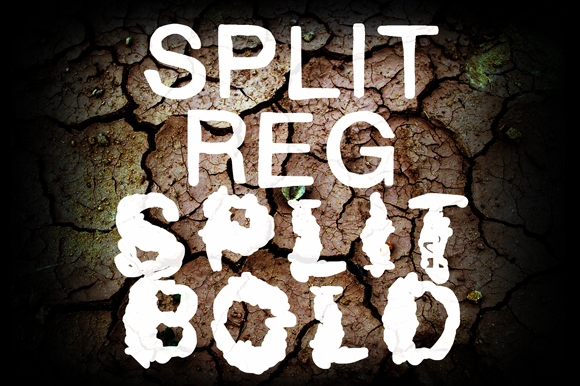
When you heat dairy too quickly, proteins clump, the texture breaks, and you end up with something that looks fragmented rather than unified. Split takes that visual metaphor and runs with it. The letters appear to crack, separate, or shift at certain angles, creating an impression of movement just as the structure begins to destabilize. But here is the crucial distinction: Split is not broken. It is carefully engineered to appear as though it might be. Every stroke, every gap, every uneven contour has been placed with intention. The light weight preserves the skeleton of the letterform while introducing subtle fissures. The bold weight amplifies those cracks, making them more structural and pronounced. Together, they offer a study in controlled instability.
For designers, this opens up a vocabulary that standard geometric or humanist fonts simply cannot provide. Instead of relying on ornamentation or decorative flourishes, Split achieves its personality through distortion. It asks the viewer to reconsider what a letter should look like. It does not scream for attention—it quietly suggests that something is off, and that is exactly the point.
Two Weights, Two Personalities
The Split font family is deliberately lean. Many typefaces ship with a dozen or more weights, offering hairline, thin, regular, medium, semibold, bold, extrabold, and black. Split resists that abundance. It offers exactly two: light and bold. That constraint is not a limitation—it is a creative boundary that forces intentionality. When you only have two options, you think harder about which one to use and why.
- Split Light: This weight retains a sense of airiness and fragility. The cracks and separations are present but subtle, almost like hairline fractures in glass. It works beautifully at larger sizes where the details become visible, but it can also function at smaller sizes as a quiet accent. The light weight is ideal for headlines in editorial layouts, branding projects that want to suggest refinement with a twist, or any context where you need elegance but not perfection.
- Split Bold: Here, the fractures deepen. The letterforms become more aggressive, the gaps wider, and the overall impression heavier. This is not a weight that whispers. It asserts itself. Split Bold is excellent for posters, album covers, merchandise, and digital hero sections where you want the typography to carry emotional weight. The bold weight leans into the dairy analogy more directly—it looks like something that has been heated unevenly and is now fundamentally changed.
Working with only two weights means you spend less time agonizing over incremental thickness changes and more time thinking about contrast, hierarchy, and tone. That is a trade-off many designers find liberating.
Where Split Belongs in Modern Workflows
Contemporary design moves quickly. Brand identities need to function across print, web, mobile, social media, and sometimes even motion. A typeface like Split, with its strong personality, requires careful placement. It is not a workhorse font for body copy—you would not set a long article in Split Light and expect comfortable readability. But as a display face, it excels. Its primary role is to attract attention and convey attitude.
Consider a music streaming platform launching a campaign for an experimental electronic artist. The artist's sound is layered, glitchy, and full of tension. A standard sans-serif would feel sterile. A script would feel disconnected. Split, particularly the bold weight, mirrors that sonic texture visually. The cracks in the letters become visual equivalents of beat drops and signal distortion. In branding, the font becomes part of the narrative rather than just a vehicle for text.
In editorial design, Split works well for pull quotes, section openers, and covers. A magazine feature about urban decay, deconstruction, or even culinary science could pair Split Light for intro paragraphs and Split Bold for breaking out key phrases. The contrast between the two weights creates a natural rhythm that guides the reader without needing additional graphic elements.
For digital products, Split finds a home in hero sections, landing pages, and app launch screens. Because the font is intentionally fragmented, it reads as modern and slightly rebellious. That aligns well with startups, creative tools, and lifestyle brands that want to differentiate themselves from corporate minimalism. However, you must use it sparingly. Overusing Split across an entire interface would create visual fatigue. Reserve it for moments where you want to stop the scroll.
Practical Benefits and Real Trade-Offs
Like any distinctive typeface, Split comes with practical considerations. Before you add it to a project, weigh the following:
- Legibility at small sizes: Split Light, with its hairline fractures, can become muddy at 12 or 14 pixels on screen. Bold holds up better but still benefits from larger point sizes. Always test the font at the actual dimensions it will be used in, especially on mobile devices.
- Pairing with other typefaces: Split is not a solo act. It needs a neutral companion for body text. A clean sans-serif like Inter, Work Sans, or even a simple serif like Source Serif Pro can provide the stable ground that Split dances on top of. Avoid pairing Split with another highly decorative font—the result will be visual noise.
- Licensing and availability: Depending on where you obtain Split, licensing terms vary. Some foundries offer it as a desktop and web font bundle. Check whether the license covers the specific use cases you need, especially for commercial projects or client work.
- Cultural and contextual fit: Split carries a specific mood. It feels urban, contemporary, and slightly uneasy. That may not suit every brand or message. A law firm, a medical institution, or a conservative financial service would likely find Split inappropriate. But a creative agency, a fashion label, or a tech startup could embrace its energy.
- Motion and animation: If you work in motion design, Split offers interesting opportunities. The cracks in the letterforms can be animated to widen, shift, or pulse. That adds a layer of kinetic storytelling that static weights alone cannot achieve.
Scenarios That Showcase Split at Its Best
Imagine you are rebranding a small-batch coffee roaster that sources beans from volcanic regions. The brand story revolves around transformation—raw bean to roasted cup, heat as a catalyst. Split Bold on the packaging label, paired with a neutral sans-serif for nutritional information, communicates that transformation visually. The fractured letterforms echo the cracking of the bean, the heat of the roast, and the intensity of the flavor. It is not a literal illustration, but the typography carries the metaphor.
Or consider a documentary poster about urban gentrification. The title sits in Split Light, thin and almost vanishing. Beneath it, a subtitle in Split Bold reads like a protest sign. The contrast between the two weights mirrors the tension between old and new, fragile communities and bulldozing development. The font does not merely present information—it participates in the message.
In motion, Split can be used for lower thirds in video content, where the letters crack apart and reform as new information appears. That technique works well for tech explainers, creative portfolios, and music videos. The two weights allow you to establish a hierarchy even within moving typography: light for secondary information, bold for primary statements.
Observations on the Design Community and Split
Reception to Split has been mixed, which is precisely what you would expect from a typeface with such strong opinions. Some designers find it gimmicky—a novelty font that will date quickly. Others see it as a tool for visual storytelling that standard fonts cannot replicate. Both perspectives have merit. The longevity of Split in your toolkit depends on how you use it. If you treat it as a crutch or a trend, it will feel stale. If you integrate it thoughtfully into projects where the concept and the typography align, it becomes timeless within those specific contexts.
What makes Split worth considering is not its technical perfection but its willingness to be imperfect. In an era of ultra-clean, optically refined typefaces, Split embraces messiness. It acknowledges that not everything in design needs to be smooth. Sometimes, the most honest representation of an idea is one that looks like it might fall apart—but holds together just enough to communicate.
The dairy analogy is fitting. Milk that overheats curdles. But curdled milk is not useless—it becomes cheese, yogurt, or a reminder that temperature matters. Split, in its two weights, asks designers to think about heat, pressure, and the edge of control. Whether that is right for your next project depends on what you want to say and how loudly you want to say it. But having a font that can speak in fractures and fissures is a valuable addition to any serious designer's palette.