Black Shepherd: When Typography Speaks in Bones
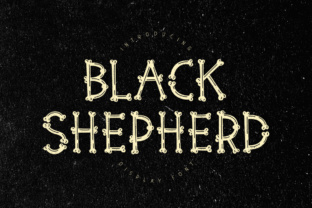
Typography has always carried a voice beyond the words it forms. Some typefaces whisper elegance, others shout authority, and a rare few evoke a primal response that reaches deep into our collective subconscious. Black Shepherd belongs to that last category. This decorative font, with each letter constructed entirely from human bones, creates an immediate visceral reaction that designers and creators have come to recognize as uniquely powerful for Halloween and horror-themed projects. But to reduce Black Shepherd to merely a seasonal font would be to overlook the intricate craftsmanship and unexpected versatility that this skeletal typeface brings to visual communication.
The Anatomy of Bone-Constructed Lettering
Understanding what makes Black Shepherd so effective begins with examining the raw material of its design. Each character is not simply a letterform with bone-like textures applied superficially; rather, every curve, serif, and terminal is built from anatomically considered bone fragments arranged to create readable letterforms. The femurs form vertical strokes, smaller phalanges create delicate curves, and the subtle joints between bones add an organic rhythm to the text that no conventional font can replicate.
What distinguishes this decorative bone font from similar offerings is the attention to skeletal realism. The designers did not settle for generic skull-and-crossbone motifs. Instead, they studied real osteological structures to ensure that the bones used in Black Shepherd maintain anatomical plausibility while still achieving the legibility required for practical use. A lowercase a, for instance, might use a curved rib segment for its bowl and a small vertebra for its counter, creating a miniature skeletal sculpture that remains instantly recognizable as a letter.
Cultural Resonance and the Horror Aesthetic
The use of bones in visual communication predates modern typography by millennia. From ancient ossuaries to Dia de los Muertos celebrations, skeletal imagery carries layered meanings about mortality, remembrance, and the boundary between the living and the dead. Black Shepherd taps directly into this cultural reservoir, but it does so with a sophistication that elevates it above novelty typefaces.
Horror font design often falls into predictable patterns: jagged edges, dripping effects, or gothic arches. Black Shepherd takes a different path. Its bone construction creates a textural authenticity that feels less like a cartoon of horror and more like an artifact unearthed from some macabre scriptorium. This authenticity matters for professionals working in entertainment, haunted attractions, and immersive experiences where audiences have become increasingly sophisticated about production value.
A theatrical production designer might use this skeletal typeface for promotional materials, knowing that the audience will subconsciously register the anatomical correctness even if they cannot articulate why the design feels more compelling than a standard horror font. The bones in Black Shepherd do not merely decorate the letters; they become the letters, creating a unity of form and meaning that stronger typography consistently achieves.
Entertainment and Media Production
Film and television producers have found Black Shepherd particularly valuable for title sequences, credit blocks, and on-screen text in horror and supernatural content. The font reads as authentic at display sizes while maintaining enough weight to remain visible when scaled down for lower-third graphics. Streaming platforms looking to differentiate their horror offerings have used this bone-constructed typeface for series thumbnails and promotional banners, where its distinct silhouette catches the eye in crowded recommendation grids.
Video game developers have embraced Black Shepherd for UI elements, menu screens, and in-game signage within horror titles. The font's bone construction aligns naturally with undead themes, dungeon environments, and ritualistic settings. Game artists appreciate that the typeface does not require additional texturing or weathering effects the bones already carry the visual weight needed to feel integrated into dark fantasy or horror game worlds.
Event Design and Haunted Attractions
Professional haunted house operators and Halloween event organizers have adopted Black Shepherd as a go-to decorative font for signage, wayfinding, and promotional materials. Unlike generic spooky fonts that can feel cheap or overused, the skeletal construction of Black Shepherd reads as intentional and high-quality. Event designers report that using this typeface for entrance signage, directional markers, and rule boards enhances the immersive quality of their attractions without requiring additional prop work or distressing.
For Halloween party planners and hospitality venues hosting seasonal events, Black Shepherd offers a way to communicate the horror theme without resorting to clichés. A cocktail menu printed in this skeletal lettering becomes part of the atmosphere rather than merely a list of drinks. The bones lend themselves to thematic presentation without overwhelming the functional purpose of the text.
Publishing and Print Media
Independent publishers of horror fiction, graphic novels, and dark fantasy have incorporated Black Shepherd into cover designs, chapter headings, and interior decorative elements. The font works particularly well for limited edition runs and collector's items, where the unique visual character of the bone typeface adds perceived value. Readers often respond to these design choices on a subconscious level, associating the skeletal lettering with the themes of mortality and dread that quality horror fiction explores.
Magazine editors have used Black Shepherd sparingly for pull quotes, section dividers, and feature headlines in Halloween issues or horror-focused special editions. The key to effective use in publishing is intentional restraint using the font as an accent rather than body text ensures its impact remains potent.
Scalability and Readability
One of the most common concerns about highly decorative fonts is their performance at different sizes. Black Shepherd has been engineered with careful attention to weight distribution and negative space, allowing it to remain legible from 24 points up to headline sizes. The bone construction creates natural thick-thin transitions that actually aid readability at smaller sizes, as the skeletal structure provides clear visual boundaries for each letterform.
However, creators should understand that Black Shepherd is not designed for body text or long passages. Its power lies in short, impactful applications: titles, logos, event names, and thematic headers. Using it for paragraphs would fatigue the reader and diminish the font's dramatic effect. Experienced designers pair Black Shepherd with clean, neutral secondary fonts for body content, allowing the bone-constructed lettering to serve as the visual anchor.
File Formats and Integration
Available in both OTF and TTF formats, Black Shepherd integrates smoothly with major design software including Adobe Creative Suite, Affinity products, and web design platforms that support custom typography. The font includes standard ligatures and basic punctuation, making it suitable for most English-language applications. Web designers can implement it through @font-face embedding for digital projects, though loading times should be considered for mobile users.
For physical production, this decorative Halloween font reproduces well in screen printing, foil stamping, and laser engraving. The detailed bone structures benefit from higher-resolution production methods, so die-cut signs and embossed invitations show the skeletal detailing to its best advantage. Creators working with vinyl cutting or routing should test the font at their intended production size to ensure the finer bone elements reproduce cleanly.
Comparative Landscape: Black Shepherd Among Horror Fonts
The market for horror and Halloween typefaces is crowded, with thousands of options ranging from the elegant to the absurd. Black Shepherd occupies a unique position in this landscape because it relies on structural verisimilitude rather than surface-level spookiness. Where many horror fonts use jagged edges, blood drips, or distressed textures to convey menace, Black Shepherd builds its impact from the ground up through its bone architecture.
Compared to skeleton-themed fonts that arrange bones arbitrarily around standard letterforms, Black Shepherd integrates the skeletal elements directly into the letter construction. This distinction matters for professionals who need typography that holds up to scrutiny. A close-up shot of a Black Shepherd headline in a film or photograph reveals consistent anatomical logic, where lesser fonts would show disconnected decoration.
Competitors in the scary font category often sacrifice readability for effect, producing letterforms that are difficult to decipher at any size. Black Shepherd maintains a careful balance, ensuring that each bone-constructed character remains identifiable while still delivering the desired macabre aesthetic. This balance makes it suitable for commercial applications where communication cannot be sacrificed for atmosphere.
Workflow Integration for Designers
Experienced typographers have developed specific approaches for incorporating Black Shepherd into their projects effectively. One common workflow involves using the font at large sizes with generous letter spacing, allowing each bone-constructed character to breathe visually. The skeletal detailing becomes more apparent when letters are not crowded together, and the negative space between characters adds to the overall composition.
Color treatment significantly affects how Black Shepherd reads. Bone-white on black backgrounds emphasizes the skeletal construction most dramatically, while parchment tones or aged paper colors create an antique, ritualistic feel. Metallic treatments, particularly silver or aged bronze, can give the font an artifact quality suitable for premium packaging or event materials. Some designers have experimented with Black Shepherd in subtle shades of off-white and gray, creating a more subdued horror effect that works for upscale or literary applications.
Layering techniques can further enhance the typeface's impact. Overlaying Black Shepherd text with subtle shadow effects, glow treatments, or texture maps can integrate the font into complex compositions without overwhelming the skeletal details. Designers working on motion graphics have found that animating the font with slow reveals or subtle bone-rattling effects creates memorable title sequences that feel organic rather than mechanical.
The Broader Context of Decorative Typography
The rise of Black Shepherd reflects a broader trend in typography toward fonts that carry inherent narrative weight. Contemporary audiences are visually literate and respond to typefaces that communicate meaning beyond the words they form. A font built from bones tells a story before a single word is read it speaks of mortality, craftsmanship, and the human fascination with what lies beneath the surface.
This bone-constructed typeface also participates in a renaissance of handcrafted digital typography, where designers seek authenticity through apparent imperfection. The organic variation in bone shapes within Black Shepherd creates a handcrafted feel that resonates with audiences tired of sterile, algorithmic design. Each letter has character without sacrificing consistency, a balance that only skilled type design achieves.
Educators teaching typography and design theory have begun using Black Shepherd as a case study in how conceptual rigor can elevate decorative typefaces. The font demonstrates that even the most thematic design can succeed through careful attention to structure, proportion, and function. Students analyzing Black Shepherd learn that decorative fonts need not abandon typographic principles to achieve their visual goals.
For hobbyists and DIY creators, Black Shepherd offers an accessible entry point into professional-quality horror design. The font's consistent letterforms and reliable rendering mean that even users with limited design experience can produce materials that look considered and polished. Halloween party invitations, costume contest signage, and social media graphics benefit from the instant credibility that well-crafted typography provides.
The enduring appeal of Black Shepherd lies in its honest craftsmanship. It does not pretend to be anything other than what it is a font made of bones, designed for those moments when ordinary typography will not suffice. Whether applied to a haunted house banner, a horror novel cover, or a theatrical production poster, this skeletal typeface carries its meaning openly, without apology, and with an anatomical precision that rewards close examination.
Creators across every discipline would do well to understand not just how to use Black Shepherd, but why it works. The bones in this font are not decoration; they are structure. They are not gimmick; they are meaning. And in a design landscape filled with fleeting trends, that kind of typographic integrity stands out like a skeleton in a crowd of ghosts.