The Story Behind Arkibal Serif: Reviving 19th-Century Gold Frame Lettering for Modern Design
In an age where digital typefaces are produced by the thousands every year, it is rare to encounter a font that carries a genuine story — a narrative woven into its very curves, serifs, and strokes. Arkibal Serif is one such typeface. Born not in a designer's studio alone, but in the dusty archives of a 19th-century gold frame factory in Copenhagen, this font bridges nearly two centuries of craftsmanship, art, and typographic tradition. Whether you are a graphic designer, a historian of visual culture, or simply someone who appreciates the beauty of well-made letters, understanding the origins and design philosophy behind Arkibal Serif offers a fascinating glimpse into how the past can be preserved and reimagined for the present.
The Historical Spark: A Great-Grandfather's Gold Frame Factory (1838)
The story of Arkibal Serif begins in 1838, when a small gold frame workshop opened its doors in Copenhagen. This was no ordinary factory. It produced guldrammer — gold frames — for some of the most celebrated artists of the era, as well as for museums across the Danish capital. The craftsmen who worked there did not simply build frames; they understood that the border of a painting was part of the artwork itself, requiring the same attention to detail, proportion, and elegance that the painter had given to the canvas.
Among the documents preserved from that workshop are handwritten notes, store signs, and letterheads, each bearing distinctive characters that reflect the typographic sensibilities of mid-19th-century Denmark. These letters, with their graceful serifs and carefully modulated strokes, were not created by professional type designers but by sign painters and calligraphers who learned their trade through decades of apprenticeship. It is this authenticity — unpolished, human, and deeply rooted in a specific time and place — that forms the emotional core of the Arkibal typeface family.
From Old Documents to Digital Typeface: The Design Process
Reviving historical lettering is far more complex than simply scanning old papers and tracing outlines. The designer behind Arkibal Serif spent countless hours studying the original documents from the gold frame factory, identifying recurring shapes, measuring proportions, and understanding the subtle inconsistencies that give hand-painted signs their warmth. The goal was not to produce a perfect replica of 19th-century handwriting but to extract the essential character of those old forms and translate them into a coherent, usable digital font.
Several key decisions shaped the outcome:
- Preserving irregularity: Unlike mechanically perfect modern fonts, Arkibal retains subtle variations in stroke width and serif angle that echo the handmade originals.
- Expanding the character set: While the historical documents only contained a limited range of letters, the modern font needed to support multiple languages, numerals, punctuation, and special characters.
- Balancing authenticity with readability: Some extreme features of the original signs were softened slightly to ensure the font works in longer text settings without tiring the reader.
The Uppercase "G" — The Foundation of Arkibal Display
Every typeface has a starting point, a single letter that captures the essence of the entire design. For Arkibal, that letter is the uppercase "G". It was the first glyph drawn, and it remains the most iconic character in the family. The choice is deeply symbolic: in Danish, the letter G stands for "Guldramme", meaning "gold frame." The "G" in Arkibal Display features a distinctive curved tail and a carefully balanced open counter that recalls the ornate cartouches found on antique picture frames.
This single letter set the visual direction for the entire typeface. Its proportions, the angle of its serifs, the contrast between thick and thin strokes — all of these decisions flowed from that initial "G." As the designer worked through the rest of the alphabet, each letter was tested against this reference point to ensure consistency of style and spirit. The result is a display font that feels both historically grounded and surprisingly fresh.
Understanding the Name: Arkibal, Arkibald, and Danish Tradition
The name Arkibal itself carries a layer of meaning that connects the font to Danish cultural history. It is derived from the old traditional Danish name Arkibald, a variant of the Germanic name Archibald, which means "genuine" or "bold." By removing the final "d," the designer created "Arkibal" — a name that sounds both familiar and slightly unfamiliar, much like the font itself. It evokes tradition without being locked in the past.
This naming choice is deliberate. It signals that Arkibal Serif is not a replica or a museum piece but a living design that honors its heritage while functioning in contemporary contexts. The name invites curiosity: what is Arkibal? A place? A person? A lost word? That slight ambiguity mirrors the experience of reading text set in the font — familiar enough to be legible, distinct enough to be memorable.
What Makes Arkibal Serif Distinctive? Key Characteristics
To understand where and how to use Arkibal Serif, it helps to identify the specific traits that set it apart from other serif typefaces, both historical and modern.
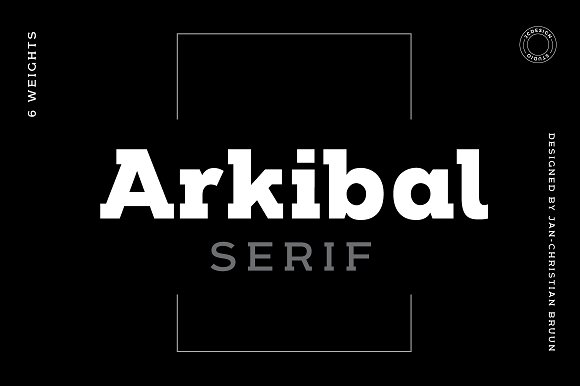
- High stroke contrast: The difference between thick and thin strokes is pronounced, a hallmark of 19th-century display typography that gives the font a refined, almost engraved appearance.
- Expressive serifs: Rather than being uniform, the serifs vary in shape and angle, some curving gently into the stem, others cutting sharply. This irregularity is a direct inheritance from hand-painted signs.
- Generous x-height: Despite its decorative nature, the font remains surprisingly readable at medium sizes, thanks to a relatively large x-height that keeps lowercase letters open.
- Warm, slightly irregular baseline: The letters do not sit on a perfectly flat line; they have a subtle bounce that mimics the natural movement of a sign painter's hand.
- Distinctive terminals: The ends of strokes often feature small flourishes or teardrop shapes that add a touch of elegance without overwhelming the overall form.
Practical Applications: Where Arkibal Serif Shines Today
A font with such a strong personality cannot be used everywhere, but in the right contexts, Arkibal Serif is transformative. Its natural habitat includes any project that benefits from a sense of history, craftsmanship, or cultural depth.
Branding for Heritage-Oriented Businesses
Museums, galleries, artisanal workshops, boutique hotels, and restaurants with a historical theme all benefit from Arkibal's authentic character. A goldsmith's logo set in Arkibal Serif immediately communicates tradition and quality without resorting to clichéd "old-fashioned" tropes.
Editorial Design and Publishing
Book covers, magazine headers, and pull quotes in Arkibal Display draw attention and establish a visual tone that is both intellectual and approachable. It works especially well for historical fiction, art criticism, and design-focused publications.
Packaging and Labels
Premium products — from craft spirits to artisan chocolates to luxury stationery — can use Arkibal Serif to convey a sense of artisanal origin. The font's connection to the gold frame factory adds a layer of authenticity that resonates with discerning consumers.
Digital Interfaces with a Vintage Edge
While Arkibal is primarily a display font, it can be used effectively in small doses on websites that want to evoke a bygone era. Headlines, navigation labels, and hero section text set in Arkibal Display add character without sacrificing usability.
Common Questions and Misunderstandings About Historical Font Revivals
When a font like Arkibal Serif enters the market, designers and typography enthusiasts often have questions about its authenticity and utility. Let me address a few of the most common ones.
"Is Arkibal Serif just a copy of an old font?" No. While it is inspired by specific historical documents, the process of creating a working digital typeface involves extensive redrawing, interpolation, and expansion. Arkibal is an original design that captures the spirit of 19th-century lettering, not a direct reproduction.
"Can I use it for long-form reading?" Arkibal Serif is best suited for display purposes — headlines, short paragraphs, and accent text. For extended body copy, a simpler, more neutral serif or sans-serif is usually preferable. The font's high contrast and decorative serifs can become fatiguing in long blocks of text.
"Does it support non-Danish characters?" Yes. Although the original inspiration came from Danish documents, the modern Arkibal font family includes a wide range of Latin-script characters, making it usable for English, German, French, Spanish, and many other European languages.
How Arkibal Serif Fits into Modern Design Workflows
Integrating a historically inspired font into contemporary projects requires a thoughtful approach. Here are some practical tips for getting the most out of Arkibal Serif:
- Pair it with a neutral companion: Use Arkibal Display for headlines and pair it with a clean sans-serif like Helvetica, Montserrat, or Open Sans for body text. This contrast highlights the font's character while maintaining readability.
- Mind the scale: Arkibal works best at larger sizes — 24 points and above for print, and equivalent sizes for screen. At small sizes, some of its finer details may become lost or muddy.
- Respect the context: The font carries historical connotations. Using it for a modern tech startup might feel incongruous unless the brand deliberately wants to evoke tradition or craftsmanship.
- Experiment with color and texture: Arkibal Serif pairs beautifully with warm, muted color palettes and natural textures like paper, wood, or stone. Avoid overly bright or synthetic environments that clash with its handcrafted feel.
Conclusion: Preserving Heritage Through Typography
Arkibal Serif is more than a font — it is a connection to a specific time, place, and craft tradition that might otherwise have been forgotten. The gold frame factory of 1838, the sign painters who lettered storefronts, the artists who depended on quality frames for their work — all of these lives and labors find an echo in the curves and serifs of this typeface. By using Arkibal Serif in contemporary projects, designers participate in a quiet act of preservation, keeping a piece of Danish cultural history alive in a form that remains useful and beautiful.
Whether you are designing a brand identity for a museum, laying out a book on Nordic art, or simply looking for a font with a story to tell, Arkibal Serif offers something rare: a voice that speaks from the past but resonates in the present. It reminds us that the best design does not merely look good — it carries meaning, memory, and a sense of where it came from. In a world of disposable trends, that kind of permanence is worth cherishing.